 Stefanos Athanasoulias
Maybe I Wanted to Be More Than an Engineer
4 min read
It's been a while since I last wrote here.
The last time I did, I was still somewhat uncertain about whether AI would be on our side or against us as software engineers. There were a lot of dark clouds hanging over our engineering community, making it even more difficult to pick a side.
Or perhaps that's an unfair accusation.
After all, if you wanted to evolve professionally in this industry, you always had to adapt to new technologies. So, what's so different about AI? Are we too stubborn to admit that, in some cases, it writes better code than we do (or articles? let that sink) ? Or that we can now get ten things done while probably washing the dishes?
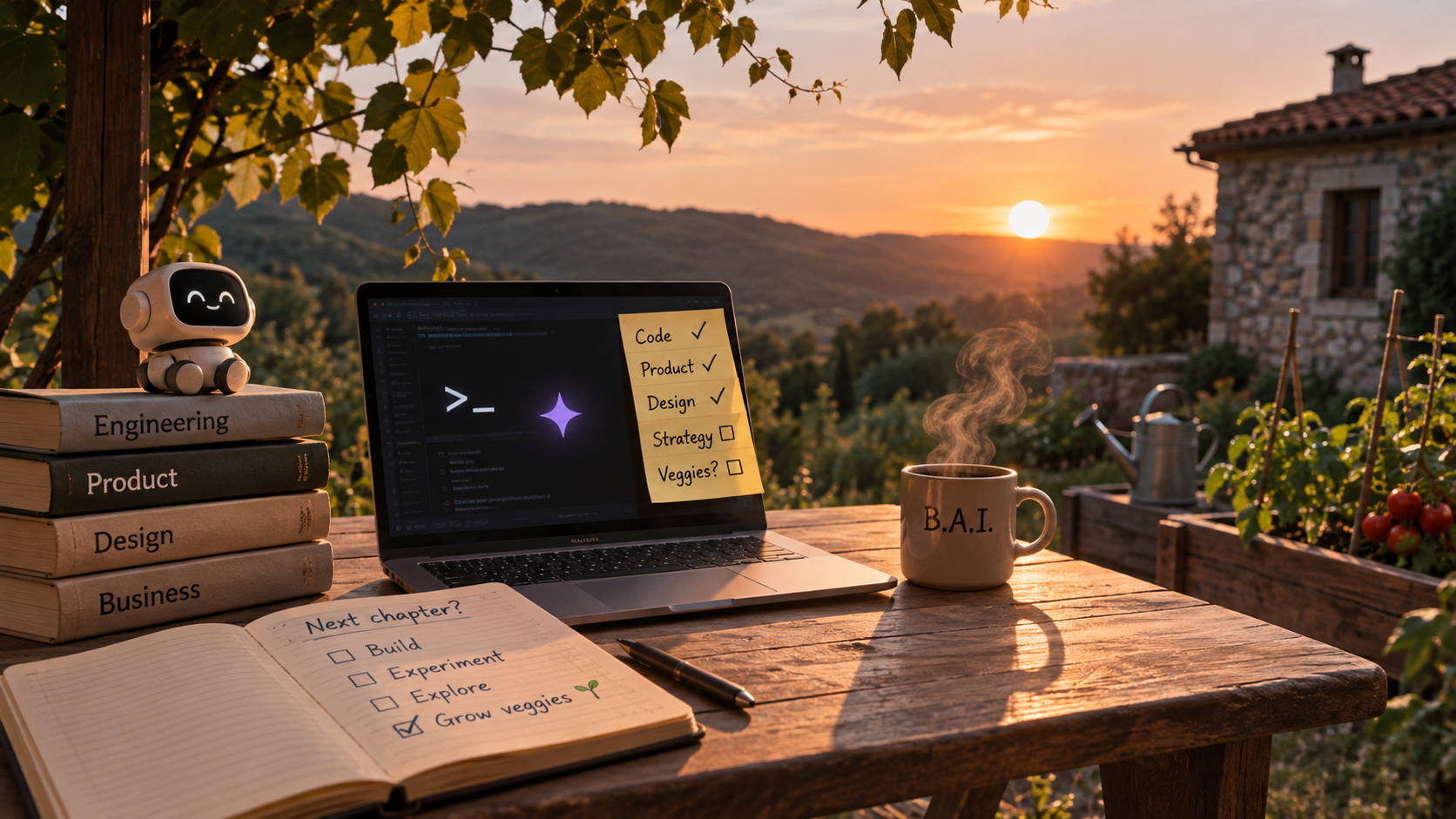
Of course, knowing the fundamentals and having spent time in the industry B.A.I. (Before Artificial Intelligence - yes, I'm making that a thing) is a significant advantage. Experience helps you adapt faster, ask better questions, recognise bad decisions and, hopefully, find your next job more easily.
But I don't really want to write about whether AI is good or bad for software engineering. There are already enough people doing that.
Instead, I want to write about my own experience (don't forget this blog serves as a personal diary after all) and how this phenomenal change happening around us has given some of us the opportunity to move in a different direction without necessarily sacrificing our expertise, seniority or salary.
The existential crisis of a frontend engineer
As a frontend engineer, I've felt that the position has become increasingly fragile with the rise of AI.
You could start picking up more complex backend tickets, get involved in infrastructure or move towards becoming a full-stack engineer. But does that really make you immune to what's happening? Probably not.
Frontend, however, feels particularly exposed.
Tools like Claude have significantly narrowed the gap between having an idea and turning it into a reasonably good-looking interface. Almost everyone can now create a functional UI for their application without spending years learning frontend development.
So, what is a frontend engineer supposed to do?
Perhaps exactly what we've been unknowingly training ourselves to do all these years.
Understand the product. Understand the user. Distinguish between something that simply works and something that actually feels right. Know when a feature adds value and when it introduces unnecessary complexity.
Writing code was never the only thing we were doing. It was simply the most tangible output of our work.
Beyond the code
I believe some frontend engineers could become the next generation of product managers, product designers, product owners and technical leaders. People who understand both the technical limitations and the business needs of a product, while being capable of turning their ideas into something tangible.
With the power of AI in our hands, the distance between identifying a problem and experimenting with a solution has never been smaller.
And I find that beautiful.
It's also something I've personally wanted to do for years. After building a few products with Kostas, I gradually realised how much I enjoyed the process surrounding the code. Thinking about the product, discussing ideas, designing experiences, understanding what people need and figuring out how to deliver it.
Maybe I was already moving in that direction without realising it.
Now, I finally feel I have the opportunity to explore it further.
Getting more things done - and more things I actually enjoy
This isn't necessarily about moving away from engineering or suggesting that writing code is somehow less meaningful than other professions.
It's also about how you can evolve within an organisation.
Moving from implementing features to architecting solutions. From executing ideas to challenging them. From receiving a ticket to questioning whether that ticket should exist in the first place.
I love the fact that I can now work on a proof of concept without spending an entire month building something that might eventually get thrown away. Instead, I can spend a few days experimenting, validating an assumption and figuring out whether an idea deserves more attention.
And if it doesn't? That's perfectly fine. Move on to the next one.
The freedom to experiment
There is something incredibly liberating about making experimentation cheaper.
For years, we had ideas that never saw the light of day, simply because the time and effort required to validate them couldn't be justified. I wonder how many good ideas we've collectively abandoned because of that.
Of course, this requires the right organisational culture. An organisation that sees AI not merely as a mechanism for reducing headcount or increasing the number of completed tickets, but as an opportunity to give people more ownership, creativity and room to experiment.
Being able to produce twice as much doesn't necessarily mean you should produce twice as much of the same thing.
Perhaps you should spend some of that newly available time doing something different altogether.
This is not a love letter to AI
Despite how it might sound, this article isn't really about praising AI.
It's about us. The humans behind the keyboards.
I've been thinking lately about how strange it is that we allow our professional titles to become such a big part of our identity.
I'm a software engineer. I'm a frontend engineer. But is that all I want to be for the next thirty years?
People change careers, interests, ambitions and entire ways of living throughout their lives. Why should we be any different?
Maybe you always wanted to become a designer. Maybe you enjoy talking to customers more than debugging production issues. Maybe you're interested in marketing, business, architecture or building something of your own.
Maybe you simply never had the opportunity, the time or the confidence to explore those interests.
Well, perhaps now you do.
You don't have to abandon everything you've learned to become something else. Your experience doesn't disappear just because you decide to use it differently.
Being an engineer will always be part of how I think, how I approach problems and how I make decisions, regardless of what my job title says.
The tools we use shouldn't define who we are or limit who we can become.
Finding the balance
Use AI. Maybe even overuse it for a while. Explore its limits, see how far your newfound addiction can go, and eventually learn how to use it effectively.
But don't become brain-dead (been there, done that) in the process.
Stay curious. Question its suggestions. Challenge your own assumptions. Read things. Talk to people. Make mistakes of your own.
Embrace this new hybrid model of human judgement and artificial intelligence. Use it to make better, data-informed decisions, but don't outsource your curiosity, creativity or critical thinking.
And most importantly, use it to explore the things you actually want to do, not just to get better at the things you're already doing.
I don't know exactly what my professional life will look like in five years. For the first time in a while, though, I find that uncertainty more exciting than frightening.
Maybe AI will eventually replace us all. Maybe Skynet will rise and render this entire article hilariously irrelevant.
In that case, I'll probably disconnect from everything, move to a country house, grow some vegetables and spend my days worrying about the weather instead of production deployments.
I mean, that's something I want to do anyway. (Hopefully you too)
See ya around.